Benefits
- Provides more clarity on the long-term viability of passenger rail service.
- Provides sound analysis to inform decision-making not only for the transportation system, but also for housing, healthcare, and economic development.
Status
The passenger rail feasibility study is underway. CPCS Transcom, a Canadian management consulting firm with worldwide expertise in rail infrastructure development, is completing the first phase of work.
The first phase of the study will:
- identify corridors with potential for rail service
- evaluate and screen potential corridors, ultimately recommending which should be assessed in more detail
- establish a foundation for additional planning and evaluation in subsequent phases, including plans for screened-out corridors
Phasing the feasibility study ensures that each stage is informed by evidence and analysis, helping to ensure that future work focuses on the most promising opportunities. Findings from phase one will shape the scope and priorities of subsequent phases to support better decision‑making and targeted analysis.
In August 2025, a request for standing qualification (RFSQ) was issued. In November 2025, five pre-qualified bidders were shortlisted and are eligible to bid on future scopes of work that comprise the full rail feasibility study.
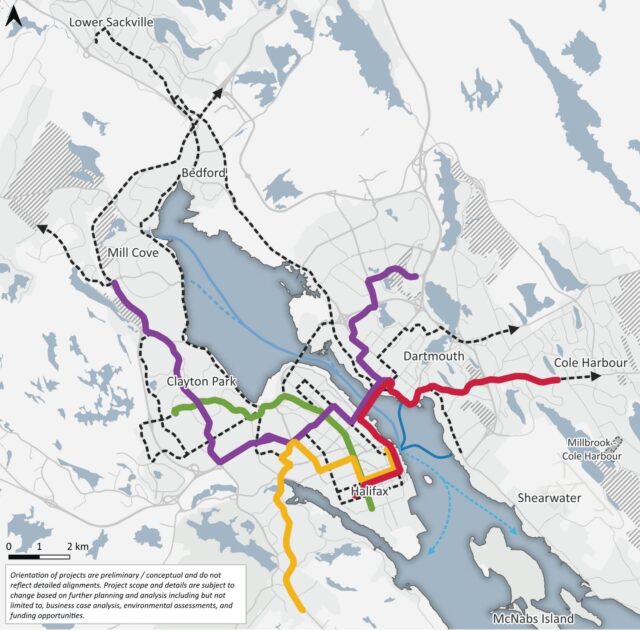
Action 3.1.3: Initiate preliminary work for a long-term strategy for Light Rail Transit (LRT) and regional passenger rail.
Passenger rail service has the potential to reshape travel in the Region by providing a very high-capacity form of transit service. Introducing this service is a significant undertaking, should target areas of potential high ridership, and would represent one of the most significant investments in the province’s history. Actions 1.3.1 that introduces inter-municipal transit service and 1.3.2 that introduces Bus Rapid Transit can establish a foundation of ridership and land use for future investments such as regional passenger rail and LRT. A passenger rail feasibility study will have an initial emphasis on connections between Halifax, Bedford, and Windsor and Halifax and Lantz.
Goal 3 | Develop a future-ready transportation system
Strategy 3.1 | Enhance system resiliency and plan for longer-term network connections
Challenges Addressed